

Hegseth Plan To Refocus Army Near Home Popular, Appetite for Intervention Persists
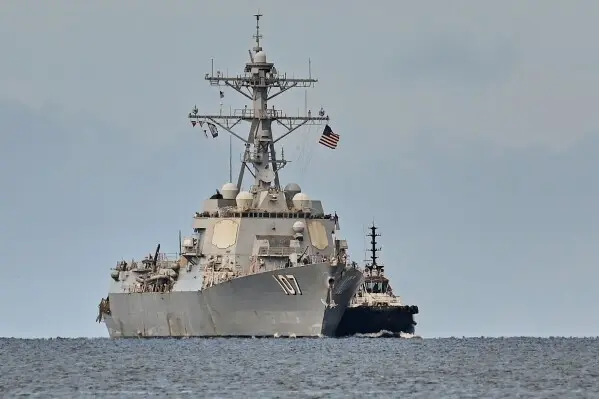
Since Sept. 2, the United States has attacked at least 22 vessels said to be ferrying drugs to the United States in international waters off the coasts of Venezuela and Colombia, killing at least 83. Despite media controversy questioning the legality of these strikes, according to the latest poll from the Ronald Reagan Institute, it is among the most popular policies pursued by the Department of War under Secretary Pete Hegseth's leadership.
The poll, taken Oct. 23 to Nov. 3 with 2,507 U.S. adults, found that 62% approved of “using military force against suspected drug traffickers in Latin America and the Caribbean.” Only 36% disapproved.
Other policies with similarly high approval from Hegseth's DOW include issuing general-neutral standards for combat jobs (62%), deploying active-duty troops and the National Guard to support border security (61%), and the U.S. airstrike against Iran’s nuclear facilities (60%). The most unpopular policy was renaming the Department of Defense to the Department of War (59% disapproved).
One note from the high-approval policies is that using troops closer to home, on the border, and in the Caribbean was similarly popular to the targeted strike in Iran. The poll also found that a growing number want the United States to be more engaged in international conflicts, up to 64% from 40% in the November 2022 Ronald Reagan Institute poll.
Still, the increased priority of the U.S. military in North and South America over Europe, the Middle East, and Africa is favored more than it is opposed (49% to 40%).
Allies and Adversaries
Skepticism about how closely the United States should be tied to other countries was most visible in how respondents viewed America’s allies. Of the 15 countries the survey asked about, only one saw an increase in the share of Americans who considered it an ally since the Ronald Reagan Institute began tracking the question in 2018. That country was Ukraine, which rose to 75% in the latest poll, up from 49% in February 2021.
For nearly every other country, the share of Americans who considered them allies either remained unchanged or declined. Israel saw the largest drop, from 80% in 2018 to 66% today. Japan’s numbers fell from 86% to 74%, and Mexico’s from 74% to 66%.
However, while some of the United States’ allies are decreasing in favorability, NATO has increased in favorability over the seven years since the poll began. In the latest questionnaire, 68% had a favorable view of the organization, up from 59% in 2018.
When it comes to America’s adversaries, Republicans have been divided over which country poses the greatest threat. Some, such as Sen. Ted Cruz, argue that a nuclear-armed Iran would be the most serious national security challenge. Others, including Undersecretary of War for Policy Elbridge Colby, have emphasized China, with Colby writing in responses to the Senate Armed Services Committee before his 2025 confirmation hearing that “The military threat posed by China is the most serious and pressing for the United States.”
Weighing in on that debate, the poll finds that a plurality of Americans think China is a much bigger threat. When asked about the greatest threat to the United States, 48% said China, followed by 26% who said Russia, 6% who responded USA/Ourselves, 4% who said North Korea, and only 3% who said Iran. China is seen as an ascendant threat, with the November 2018 poll having only 21% respond that China was the biggest threat, while 30% and 18%, respectively, said Russia and North Korea were the top threats. Among Republicans, 61% believe the threat of China is an even bigger concern, while only 4% said Iran was the biggest threat.
Trust in the Military
During the Biden administration, the Department of Defense faced scrutiny on several fronts. Strategic failures, most notably the Afghanistan withdrawal that resulted in the deaths of 13 service members at Abbey Gate at the hands of ISIS-K, drew significant criticism. The department also came under fire for recruiting ads aimed at specific diversity groups.
Under the Trump administration, the Department of War has faced a different set of criticisms from Democrats, who argue that the military is being politicized. They point to the firing of senior military leaders, including Joint Chiefs Chairman Gen. C. Q. Brown, as well as more recent concerns about a second strike on a Venezuelan drug-trafficking vessel. According to The Washington Post, that follow-up strike could qualify as a war crime if it was meant to target two survivors holding onto the boat's debris.
The increased scrutiny of the military from both sides during the other party's administration has led to a significant decrease in trust of the military. In the 2018 poll, 70% said they had “a great deal” of trust and confidence in the military; the latest poll had only 49% say the same. Respondents saying they had only “a little” or “not much at all” trust/confidence in the military had climbed from 6% in 2018 to 22% in 2025.
In another question, only 41% said they thought that the U.S. military is “appropriately balancing a focus on warfighting and social issues,” while 25% said it is too focused on social issues at the expense of a focus on warfighting, and 23% said it is too focused on warfighting at the expense of a focus on social issues. Those polled had a very similar response in 2023, varying by only about 2% on each answer.
State of Union
.
